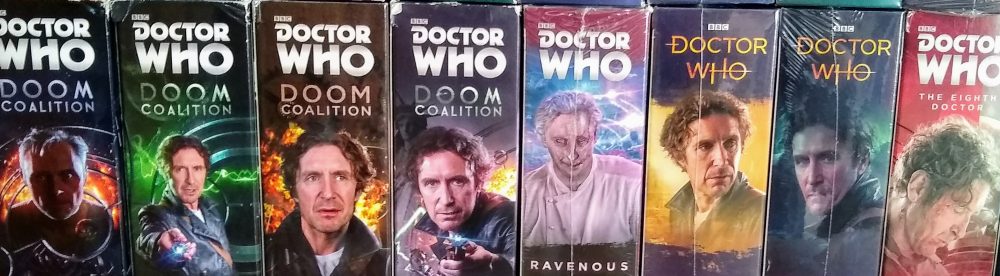
Written by James Goss and directed by Ken Bentley.
The Legacy of Time episode 1.
Spoiler-free verdict: Two of Doctor Who‘s very best characters, River Song and Bernice Summerfield, meet at last, something that could easily sell a story in of itself, but Paul McGann has to go and give one of his best performances ever and steal the show. In other words, shockingly good.
Recommended pre-listening: The Sirens of Time
***
19 July 1999, the first Big Finish Doctor Who audio, The Sirens of Time, was released. It wasn’t their first release overall (Oh No It Isn’t, September 1998), nor even most of the creative team’s first Who audio work (the Audio-Visuals and BBV productions), and it is not even their best, but there is nonetheless something totemic about it, and it ushered in much that is worth celebrating. Someone had to draw a line somewhere, and it was as good a place as any. So here we are, twenty years later, with a six hour celebration of everything that’s been built off that audio. What is there left to build on it?
Well, as Lies in Ruins reveals, quite a lot. Time has passed, and Big Finish has changed with it. The company is full of writers who hadn’t worked on a single line of published Who in their lives in 1998, one of whom wrote this story, and the company has acquired rights to beloved characters who had yet to ever exist.
So, River Song, face of the new, meets Bernice Summerfield, the first face this company saw. I expected this to be fun; these are two of my favorite characters in an anniversary celebration story, fun seemed guaranteed.
This was not fun.
Lies in Ruins is a prickly, difficult, angry thing, with characters who can’t stand each other being driven to desperate places, brought to life by some of Big Finish’s most talented performers bringing their A-Game. There’s a degree to which that’s dissapointing; I still want a story of River and Benny having flirty fun quite desperately, and it’s a shame neither character gets much lighter emotional interaction with the Doctor here. But what is offered in its place is so incredibly good that complaining seems a foolish thing to do.
For starters, the River and Benny relationship is in no way interpreted how I’d have imagined it. Author James Goss notes in the extras that it would be easy to have a version of this story in which they’re terribly witty and tearing each other apart the whole time. I can’t say that’s something I agree with at all as a reading of the characters, but in practice, it works, and works particularly well for an aniversary. These characters are two tremendously different takes on a similar starting point, divided by the existence of the new series, and so discussing the ways they compare and contrast in the midst of the Time War, the metatextual break, between classic and new, is particularly sharp. But beyond that, it works because the story gives them another take on the companion to use as a punching bag.
Enter Ria, played by Torchwood star Alexandria Riley. She is, by design, a fairly vapid and hateful character, impossibly naive and far too eager. In my fairly critical review of The Sirens of Time, I said I felt like the Sirens themselves were a less than charitble commentary on the companion archetype, complete with twisted ankle joke. Well, here, Ria does, in fact, twist her ankle, and in general feels like a response to those themes in Sirens. The difference is, while in Sirens, the twist was that the apparent companion is an evil temptress, here, the apparent siren is, in fact, a creation of a man, the Doctor, to fill a reductive role and make him feel good.
It’s a tremendously difficult balance to strike. The Doctor is particularly monstrous here, both in what he does with Ria and the murder he is willing to commit against the scavengers to save what he believes to be the ruins of Gallifrey. Perhaps the strongest scene of the episode, for my money, is Ria’s confession to Bernice that the Doctor terrifies her; I don’t think there’s ever been a more unnerving picture of what the Time War does to the character. And my God, Paul McGann sells it. The script sells it. This is unmistakably the Eighth Doctor, and unmistakably as dark as he can go. Plus, there’s one other twist: while Ria is naive and empty at first, she reaffirms love for this series that overrides all, for the adventures, the heroism, the cleverness, the heart, the words over weapons. Her death hurts, but it’s a necessary hurt for the darkest of days, and restates why what she embodies does, in fact, matter.
And while this story fails to be in any way about River or Bernice themselves, it needs them to show the light on either end of that tunnel, calling the Doctor out (and checking him out, this is McGann’s Doctor) in a way Ria never could. “War doesn’t suit you,” declares River at the climax; it’s an obvious conclusion, but a necessary and beautiful one. The final scenes are full of grace notes, finding the beauty coexisting with the tragedy, and reminding the listener that, however dark it gets, Doctor Who comes out the other side, out of the wilderness years, through the new series, and beyond to whatever lies next.
This is an unpleasant, difficult hour of audio drama, with the most harsh and prickly performance I’ve ever heard the Doctor given. But because of how it faces that, building on and responding to an old story by applying new values and great humanity, it captures everything I love about Doctor Who along the way.
Lies in Ruins is a masterpiece.
10/10
 Scriptscribbles Reviews