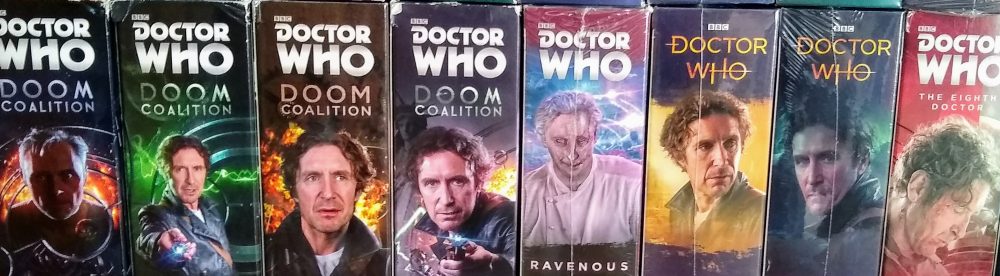
The Legacy of Time – Lies in Ruins

Written by James Goss and directed by Ken Bentley.

The Legacy of Time episode 1.

Spoiler-free verdict: Two of Doctor Who‘s very best characters, River Song and Bernice Summerfield, meet at last, something that could easily sell a story in of itself, but Paul McGann has to go and give one of his best performances ever and steal the show. In other words, shockingly good.

Recommended pre-listening: The Sirens of Time

***

19 July 1999, the first Big Finish Doctor Who audio, The Sirens of Time, was released. It wasn’t their first release overall (Oh No It Isn’t, September 1998), nor even most of the creative team’s first Who audio work (the Audio-Visuals and BBV productions), and it is not even their best, but there is nonetheless something totemic about it, and it ushered in much that is worth celebrating. Someone had to draw a line somewhere, and it was as good a place as any. So here we are, twenty years later, with a six hour celebration of everything that’s been built off that audio. What is there left to build on it?

Well, as Lies in Ruins reveals, quite a lot. Time has passed, and Big Finish has changed with it. The company is full of writers who hadn’t worked on a single line of published Who in their lives in 1998, one of whom wrote this story, and the company has acquired rights to beloved characters who had yet to ever exist.

So, River Song, face of the new, meets Bernice Summerfield, the first face this company saw. I expected this to be fun; these are two of my favorite characters in an anniversary celebration story, fun seemed guaranteed.

This was not fun.

Lies in Ruins is a prickly, difficult, angry thing, with characters who can’t stand each other being driven to desperate places, brought to life by some of Big Finish’s most talented performers bringing their A-Game. There’s a degree to which that’s dissapointing; I still want a story of River and Benny having flirty fun quite desperately, and it’s a shame neither character gets much lighter emotional interaction with the Doctor here. But what is offered in its place is so incredibly good that complaining seems a foolish thing to do.

For starters, the River and Benny relationship is in no way interpreted how I’d have imagined it. Author James Goss notes in the extras that it would be easy to have a version of this story in which they’re terribly witty and tearing each other apart the whole time. I can’t say that’s something I agree with at all as a reading of the characters, but in practice, it works, and works particularly well for an aniversary. These characters are two tremendously different takes on a similar starting point, divided by the existence of the new series, and so discussing the ways they compare and contrast in the midst of the Time War, the metatextual break, between classic and new, is particularly sharp. But beyond that, it works because the story gives them another take on the companion to use as a punching bag.

Enter Ria, played by Torchwood star Alexandria Riley. She is, by design, a fairly vapid and hateful character, impossibly naive and far too eager. In my fairly critical review of The Sirens of Time, I said I felt like the Sirens themselves were a less than charitble commentary on the companion archetype, complete with twisted ankle joke. Well, here, Ria does, in fact, twist her ankle, and in general feels like a response to those themes in Sirens. The difference is, while in Sirens, the twist was that the apparent companion is an evil temptress, here, the apparent siren is, in fact, a creation of a man, the Doctor, to fill a reductive role and make him feel good.

It’s a tremendously difficult balance to strike. The Doctor is particularly monstrous here, both in what he does with Ria and the murder he is willing to commit against the scavengers to save what he believes to be the ruins of Gallifrey. Perhaps the strongest scene of the episode, for my money, is Ria’s confession to Bernice that the Doctor terrifies her; I don’t think there’s ever been a more unnerving picture of what the Time War does to the character. And my God, Paul McGann sells it. The script sells it. This is unmistakably the Eighth Doctor, and unmistakably as dark as he can go. Plus, there’s one other twist: while Ria is naive and empty at first, she reaffirms love for this series that overrides all, for the adventures, the heroism, the cleverness, the heart, the words over weapons. Her death hurts, but it’s a necessary hurt for the darkest of days, and restates why what she embodies does, in fact, matter.

And while this story fails to be in any way about River or Bernice themselves, it needs them to show the light on either end of that tunnel, calling the Doctor out (and checking him out, this is McGann’s Doctor) in a way Ria never could. “War doesn’t suit you,” declares River at the climax; it’s an obvious conclusion, but a necessary and beautiful one. The final scenes are full of grace notes, finding the beauty coexisting with the tragedy, and reminding the listener that, however dark it gets, Doctor Who comes out the other side, out of the wilderness years, through the new series, and beyond to whatever lies next.

This is an unpleasant, difficult hour of audio drama, with the most harsh and prickly performance I’ve ever heard the Doctor given. But because of how it faces that, building on and responding to an old story by applying new values and great humanity, it captures everything I love about Doctor Who along the way.

Lies in Ruins is a masterpiece.

10/10

Virgin New Adventures – No Future

Written by Paul Cornell.

Virgin New Adventure book 23.

Spoiler-free verdict: A frothy evolution of Virgin’s vision of Doctor Who into principles of feminist fandom and political activism, and a fun and emotional story to boot, if a little mispaced in the plot.

Recommended pre-reading: Love and War, Deceit, Blood Heat, The Left-Handed Hummingbird, Conundrum.

***

For a series that birthed itself with two major plot arcs, Timewyrm and Cat’s Cradle, the Virgin books have grown light on long-form storytelling. The Alternate History Cycle, beginning with Blood Heat, has been something of a much-needed shakeup, and on the whole, No Future is an utterly wonderful bit of closure.

For those just joining in, the last few books have revolved around a figure messing with the timelines, creating alternate realities which the Seventh Doctor, Bernice Summerfield, and Ace are forced to clean up after. This has been used to draw out several new conflicts in the team, some more organic than others. On the more forced end of things, Ace and Benny have increasingly gone at each other’s throats, something which has provided many frustrating moments, and continues to here, but also some real triumphs, including many of my favorite moments of the previous book, Conundrum. Mostly, this serves Ace as a character; “New Ace” has been a famously prickly prospect for both writers and readers, and so by putting her into conflict with Bernice, these issues can be externalised and resolved through repairing her relationships. Meanwhile, both companions are put into a place of questioning the Doctor, mostly built on his destruction of the alternate universe from Blood Heat, which over the course of the arc serves as a sort of exorcism of the inadequately addressed destruction of a solar system at the climax to The Pit.

If this sounds like a lot of clean-up work, that’s because it mostly is. No Future takes on these conflicts in order to establish a sort of clean playing field for the series going forward. On the whole, it succeeds at this very well. Ace’s surrogate companion relationship with the Meddling Monk (unsurprisingly, the Time Lord responsible for mucking with history), while a ruse to play both him and the Doctor, serves to highlight her needs as a time-traveller. And both she and Benny get to have a go at experiencing what it’s like to be the Doctor through the brilliant choice of faking his death; Ace gets to pull the strings in arranging these machinations, and while thinking he’s dead, Benny gets to briefly serve as the frothy adventurer the Doctor once was and illustrate a different kind of hero. The Doctor gets a little bit less, having been thoroughly interrogated by Kate Orman’s The Left-Handed Hummingbird, but there’s some wonderful payoff for both him and Ace in regards to that book’s themes, of whether the Warrior can become the Healer. The answers are complicated but meaningful, and it’s no wonder that provides a thematic basis for numerous new series episodes.

That isn’t to say all the character is successful. Though Ace gets much-needed and quite beautiful development, particularly in the first and last thirds of the book, in the lengthy middle section, the nature of the plate-spinning plot means that her motivations are murky, and thus her emotional interiority largely disappears. This isn’t a total wash, as there’s some gorgeous scenes between her and Benny’s anarchist bandmate Danny Pain allowing her to vent away from the Doctor and Benny. The plot shares these issues. Major reveals like Artemis the Chronovore or the Brigadier’s true allegiances are held back far longer than needed, resulting in a deneument to the book that grinds to a halt for the Doctor to explain everything for a few pages.

In a lesser book, pacing issues like this would be fatal, and they have been to several past New Adventures. But Paul Cornell is too talented to leave this slack middle space empty. This book is awash with meaningful ideas and aesthetics to keep things moving in meaningful ways. For a start, it continues the engagements with metafiction from Conundrum to comment on Doctor Who, both with the hilariously rubbish Vardans manipulating media space and with the Monk using Artemis to edit Doctor Who stories to get his victory. The opening chapter is a particular triumph in this regard, the Monk watching a fairly stereotypical action adventure result in the brutal death of Ace.

Metafiction for metafiction’s sake is fun, as Conundrum illustrated. But No Future’s engagement with punk and politics takes it a step further, utilizing metafiction to make a political statement on what Doctor Who can be. Some of this happens in small ways, such as Ace complimenting Danny’s “this machine kills fascists” line, or Ace shooting the Queen, or… well, anything with Ace, really, who returns to her “bring down the government” Cartmel roots. Benny joining an anarchist punk band similarly delights, as does Captain Mike Yates’ ascension into anarchy and studded leather. There’s also a delightful acknowledgement of Who fan culture in general, with the Doctor becoming a hero of rumor in fanzines. But some of it cuts deeper and rawer, particularly the more queer and feminist sections. Ace’s story comes down to a sapphically-tinged relationship with the beautiful Artemis, who she frees from being chained to a bed (and who Vardan Pike eagerly ships with Ace), a dynamic which allows her to take total control of the narrative and heal her broken heart.

But for me, the best moment of all is in a little anecdote from Danny about errors made romancing a rape victim. It’s awkward and uncomfortable, a case of a man pushing too hard and hurting someone vulnerable out of not knowing when to shut up and respect boundaries. Ordinarily, telling this story from the perspective of the man approaching the victim is a horrible choice. But the sheer tenderness, the focus on the victim’s needs, and the way failing to help someone in need makes Danny feel like a monster results in something that took my breath away, a gorgeous little moment of humanity. It’s feminist, but it’s feminism from the perspective of the way people can unknowingly perpetuate toxic masculinity, a perspective Who damn well needs, given how long it’s been a man-dominated world (and in many ways continues to be). Moments like this push No Future into something forward-looking and vital, exactly what’s needed after the first ever woman-written Who novel in The Left-Handed Hummingbird.

And that’s the real triumph of No Future: the way it repairs and looks forward. As befits the seasonal theming of summer, this book is about brushing away the wounds and the cold and embracing a frothier, frockier, more feminist future for Doctor Who. It feels like a long time since one of these books ended with the Doctor and friends, heading off on another great adventure, but for once, in the shining light of summer, that’s exactly what’s needed. It’s a step forward into a bright future.

9/10