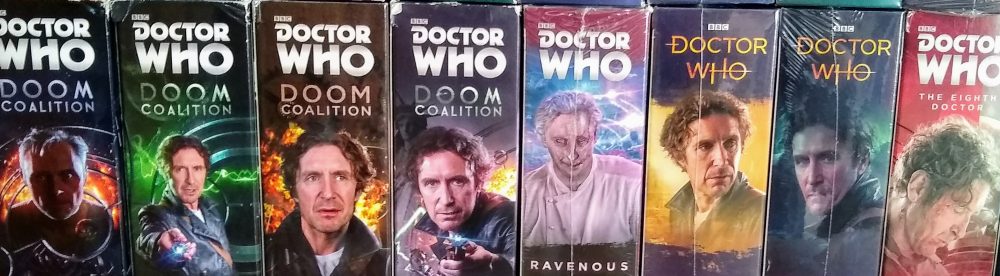
Eighth Doctor Adventures – Vampire Science

Written by Jonathan Blum and Kate Orman.

Eighth Doctor Adventures book 2.

Spoiler-Free verdict: A pacey, character-driven romp that establishes its new leads well, if shortchanging some of its ideas and guest cast in the process. Overall, a solid introduction to a new books range and Doctor.

Recommended pre-reading: None.

***

Vampire Science is a book that cannot be divorced from its context. As the second EDA, and the first in the line engaged in creating a sustainable new direction for its undeveloped Doctor and companion, it has a lot to do. What follows is, essentially, 280 pages of pilot material, and the book lives or dies based on how well that material works for you.

Structurally, this is well done. The first chapter in particular is a marvel, written as its own self-contained short from the perspective of guest character Carolyn. It succeeds tremendously, showcasing business as usual for the Eighth Doctor and Sam Jones and freeing up the rest of the book to get under the hood a bit more. The choice of setting this section in a lesbian bar is immediately engaging and fresh, it must be said; there’s still not enough sapphic content in Who two decades later! And beyond that, framing Sam through Carolyn’s crushing gaze is a strong way to reintroduce this new companion, as well as to define Carolyn’s later dynamic with both characters. After a taste of self-contained adventure, Carolyn misses out on life as a companion, setting up the main concern of this book: what does it take to be a Doctor Who lead in this new era? The rest of the book exists to find answers, and as is expected from these authors, the findings intruige.

From here, the book builds itself around challenging who this new Doctor and Sam are. Primarily, this comes from their relationships with Carolyn and new UNIT head Adrienne Kramer. The Doctor is immediately set in contast to his predecessor, who knew Kramer, winging it and hyperfocusing on resolving minor struggles and emotional crises rather than master plans. For me, the best moments of this book come when he gets distracted from the plot to buy ice cream, or cook breakfast, or arrange funerals for bit players. Meanwhile, instead of the typical first trip beats familiar to new series fans, Carolyn’s dilemma of whether to choose her life with her husband or travels with the Doctor helps fuel an arc about whether or not Sam really wants to be the companion, a decision I have been lead to believe is far less developed in the preceeding book. Additionally, Kramer and vampire Joanna Harris challenge Sam on how prepared she is for this, with the latter confronting Sam over political correctness in a standout scene.

The open-ended responses to these character questions are generally the strongest parts of the book. For the Doctor, whether his fiercely small-scale view is more humane or more dangerous is left in the air, through application of emotional realism to the consequences of his recklessness in comparison to his predecessor’s manipulations. He may be there to fix your marriage or make sure you get a good night’s sleep, but he might also forget you at a Greenpeace rally for a year. The book even directly questions the audience on whether they’d prefer “Someone who knows exactly what he’s doing and has it all under control, or some fellow who makes it up as he goes along, and still makes it happen”, suggesting him to be the former, though with hints of the latter still present for readers to seize upon if they wish, particularly in the final plot resolution. This all sets up a rewarding model for characterization, as well as a tension for future writers to play with.

Sam, meanwhile, gets a bit more closure, but only enough to get her to a new starting point. Her ultimately realizing that she chose to travel with the Doctor so that her political ideals wouldn’t just be all privileged talk is interesting, giving her a strong call to action without making her seem preachy or naive. There’s plenty of debate that can be had over whether the role of Doctor Who companion particularly qualifies as praxis, but it works well at giving her a proactive role in the series. Her role in the climax to the book is pleasantly grueling, as well, putting her in a visceral fight-or-flight situation against a particularly deadly and unstable vampire to prove herself to herself and the reader. It’s easily the tensest and most horrifying moment here, and as is frequently the case for putting Who leads through the wringer, she emerges stronger for it.

Beyond these successes, the story starts to reveal its limitations. The debate between Sam and the Doctor over whether the vampires deserve sympathy and to be saved, for example, fizzles out without practical solution. There’s sharp choices there, such as putting Sam against the saving of their lives despite her beliefs, but it’s slender enough to start to feel stiltedd. The plot of creating a human blood substitute, the center of this debate, is a bit of a disappointment; the concept of a human blood farm is suitably horrifying, but undercooked here. The book struggles to substantiate why Joanna Harris is worthy of redemption while also arguing that she’s created an entire sentient species to exploit, no matter how efficiently unpleasant the antagonist, Slake, is, to draw attention away. Harris’ final redemption is one of the book’s most interesting moments, but I’m not entirely convinced of all the groundwork. I can’t fault the ambition of the debate, but I’m sure the book is up to the task, especially not when it has so much else to do.

This same issue reflects even worse on the plot with Dr. Shackle, a depressed doctor manipulated by Harris into contemplating suicide and, eventually, vampirism. While it’s hard to picture a version of this book not featuring a character getting turned, my personal feeling is that a depressed character being driven to self-harm is a plot that deserves more breathing room than it can possibly have in a book that’s busy establishing what will go on to be a 73-installment range. As a result, it feels a bit crass to me, and choosing to end the book not on the establishing of the Doctor and Sam, nor Carolyn’s PoV, but rather Shackle contemplating suicide by sunlight, feels a little tasteless to me. For such a warm, witty, and enjoyable book, it felt very out of place as a closing note.

Overall, then, Vampire Science is a qualified success. It succeeds where it matters most, creating sustainable characters and storytelling modes for a long-running book line and sprinkling in enough genuinely compelling ideas to function on its own terms. It also oozes charm, from strawberry ice cream to vampire crack squirrels. But it can only go so far with even its best ideas, and it’s clear the best of the range lies ahead, not here.

It’s good. But as far as Orman and Blum go on this range, I’ll take Unnatural History over it any day.

7/10

Torchwood – Serenity

Written by James Moran and directed by Scott Handcock.

Torchwood monthly range release 29.

Spoiler-free verdict: A burst of concentrated fanservice which never quite manages to unite its disparate elements into a deeper meaning, but is far, far too much fun to care.

Recommended pre-listening: None.

***

Where to begin with Torchwood fandom? Well, perhaps where this story did in its promotion, with a single copy left for whomever might claim it at a shrine devoted to Ianto Jones on Mermaid Quay in Cardiff. The popularity of Ianto and his relationship with Jack Harkness is a powerful core of Torchwood‘s reception, and continues to dominate fandom conversation to this day, particularly in terms of shipping and fanfic.

What that means is, when it comes to an easy sell of a Torchwood audio, official Jack/Ianto fake-married comedy is utter gold, the easiest success story since some bright little guy decided to tell the story of how the two shacked up in the first place. Serenity is a perfectly-engineered tactical strike in getting the approval of anyone who considers themselves a Torchwood fan.

As a Torchwood fan who eats this stuff up, but also a bit of a miserable git of a critic, that puts me in an interesting position. Serenity is genuinely, thoroughly delightful. The first 30 minutes or so are some of the most fun I’ve ever had with Big Finish, and that’s alongside competition as stiff as Jackie Tyler, singing killer Muppets, or the Grel (if you don’t know that last one, you haven’t lived… or laughed). The pleasures come quick and hit the mark beautifully, with a wonderful wave of innuendo and mundane passive-aggression perfectly capturing the horny hell of suburban repression. There’s a few things to take away from this, most importantly that Gareth David-Lloyd as Ianto is utterly incredible at playing this material, his seething rants about the “Best Kept Lawn” competition and “spit-roasts” adding up to, for my money, possibly his best performance ever. He attacks this tremendously witty script with gusto, with incredibly rewarding readings to every line.

Similarly rewarding is the pathos in plonking Jack and Ianto down in a domestic situation. The script wisely keeps this from being perfect fluff; fanservice without in-character frission somewhere along the line can feel a bit empty. Instead, there’s always a sense of this being an awkward fit for the characters, with Jack dumping Ianto in this life 24/7 while skipping to and from the Hub being a particularly delightful source of tension. But that sense of tension makes the amount of joy they get from this life all the more rewarding; small moments like them washing a car together, with Ianto eagerly ordering Jack to take off his shirt, combine with the tension to create a properly lived-in sense of domestic bliss. Their arguments also provide a source of external relationship commentary from neighbor Vanessa (Ellie Darvill), whose monologue about losing her husband and the value of loving each other in every moment perfectly hits the balance between the angst of Torchwood fans knowing Ianto’s fate and the joy of them seeing the moments they’re happy together first. In short, this is a sharply done relationship study that knows exactly which buttons to press to get the crowd going wild.

But the fanservice also ticks a different box in the return of a monster from the Torchwood TV series. As with Broken, Serenity shows Big Finish saving their big Jack/Ianto monthly slot for the return of a writer from the TV series, in this case James Moran, author of, most notably, Children of Earth Day Three, but most relevant to this audio, of series 2 episode Sleeper. This is, it has to be said, functioning on an entirely different register of fandom consumption; certainly, my experiences with Torchwood fandom has rarely produced people interested in discussing monsters of the week as the draw. Most conversation about Sleeper I’ve seen have revolved around Ianto’s sass and the “let’s all have sex” line. And in my view, it strains the pleasures of the audio somewhat.

That is not to say the Sleepers aren’t a good fit. They are, for the themes of this story, a fantastic fit. But the tone of this story entirely changes when they arrive, emphasized by Blair Mowat’s excellent score, which shifts from the glib suburban new compositions of the front half to bringing back the thrilling motif composed for Sleeper on TV in the back. Much of the first half of the story sets up a world and characters that ultimately matter little to the final thrust of the story, and the comedy quickly dies away into action-adventure. Structurally, a lot of this mirrors the TV episode, which went from an intimate personal drama to a budget-breaking action movie midway through. But whereas that episode higned itself around one woman’s quest to hold onto her human identity, this just isn’t interested in the question; Bob, Kelly, Vanessa, all the neighbors are not valued much by this story once the invasion switch is flipped, and their personas are never heard from again. While the deneument does make a nice parallel between the Sleepers and Jack and Ianto as people who can sit in this suburban ideal but never quite stay a part of it, it never quite makes deeper connections I’d long for between this suburban world and the invasion lurking underneath.

Most notably, the climax features the Sleeper formerly known as Bob (Joe Shire) lecturing Jack and Ianto about how the violent tendencies of humanity will doom it, which is itself a strong, weighty idea. And this story does provide evidence of that destructive evil in the suburban world it creates. For me, one of the most expertly-written and overall memorable moments is the thinly-veiled homophobia in Bob’s reaction to Jack and Ianto winning the lawn award, which is just the right amount of pleasant external packing on underlying evil to be so, so human. But the thematic connections never quite materialize, which feels like a missed opportunity; for all the teases of Bob’s crushing on Jack and potential swinging, the story’s handling of destructive sexuality never quite erupts into anything, and franky, I feel cheated out of more swinger comedy, because that was gold. Contrasting the Sleepers with Jack and Ianto is as far as the script overtly goes toward thematic resolution. The big ideas are juggled, and they are good, but they never quite get there the way I’d like them to.

But then, maybe that’s just because Jack and Ianto are just too big to do anything else with, and maybe this story is just clever enough to know it. The biggest dramatic moment doesn’t come from the Sleepers themselves, but from Ianto shooting Jack to prove he is him. And similarly, the heart of this story doesn’t come from the neighborhood that Jack and Ianto let get blown to smithereens, residents included, for dramatic effect, but rather the moments we get to spend with them trying to make a life work there, just for a little while.

Perhaps Serenity doesn’t entirely get where it’s going on the big monster plot. But it knows what matters most to Torchwood fans, and goes for the jugular. And they, like me, will love it.

8/10

Torchwood: God Among Us – A Mother’s Son

Written by Alexandria Riley and directed by Scott Handcock.

Featured in Torchwood: God Among Us 3.

Spoiler-free verdict: The high-stakes escalation of the God Among Us arc takes a much-needed step back for a furiously poignant series standout.

Recommended pre-listening: See list.

***

God walks the Earth. A group of space bureaucrats called the Committee have exploited God’s powers for their own gain. Yvonne Hartman is back from the dead via parallel universe shenanigans, leading Torchwood, and cutting deals with said Committee. Oh, and all this leads to God’s powers flooding Cardiff with an enormous tsunami.

Suffice to say, there’s been a lot going on in God Among Us, Big Finish’s “sixth series” of Torchwood, particularly after the cliffhanger to Eye of the Storm, the finale to the previous set. So, as is becoming structural custom for this range, we pick up the action many days later, from a new point of view. This is a strategy that can work brilliantly or backfire, and Big Finish Torchwood is full of numerous examples of both, even in this box set. But for this episode, at the very least, it is an approach that yields nothing but gold.

A huge part of why it works in this case comes down to the choice of point of view. Bethan, a grieving mother looking to find her son in the aftermath of the tsunami, is a very poignant construction, and is made an even better idea through the casting of Mina Anwar. As viewers of The Sarah Jane Adventures can attest, Mina Anwar is always a good idea. The script is also full of cynical sharpness that takes this good idea to painfully real heights, such as in Bethan’s willingness to be exploited by TV and force herself to cry again and again just to sustain ratings and keep her son’s name in the public eye. Strongest of all, though, is her obsession with keeping her phone battery charged, a pleasantly ordinary fixation that turns into a deeply poingnant, understated reveal in the end, elevating Bethan’s plight with just the right sort of gut-punch of guilt and personal failure. In short, Bethan is a winning presence on every level, and is responsible for a good portion of the story’s success.

Also successful is the way the story uses the scaffolding of previous episodes in the Torchwood audio range to create a vivid portrayal of a community at breaking point. Unlike most episodes in this range, there are no actual new science fiction conceits here, and there don’t need to be. Instead, A Mother’s Son takes existing characters, locations, and concepts and shows new angles to them, both as a result of Bethan’s perspective and as a result of the flooding crisis. The use of Mr. Colchester’s apartment complex established in A Kill to a View in the second set of Aliens Among Us, for example, elegantly ties the class tensions and community concerns of that story into the new status quo without need for establishing significant new material.

Best of all, however, is the integration of Orr, a character who was sadly absent from God Among Us 2 and who I feel hasn’t always been given as much material as they deserve. The desire-based shapeshifter has moved on past taking the form of whatever people desire to get off with and onto deeper personal needs, with heartrending results. Having the grieving of a mass disaster latch onto them for comfort is a breathtakingly good idea, and Bethan’s failure to keep that comfort to herself is a wonderfully human tragedy. Not everything about Orr’s use here is perfect—their survival at the end of God Among Us 1 isn’t explained until far too late in this set, and there’s a mildly awkward moment where Bethan refers to this non-binary character with she/her pronouns—but the strength of this concept and the rawness of the execution mean it is nonetheless the best use of the character, bar none, and a very memorable emotional experience to hear. Once again, Bethan’s interactions with the fixtures of this world showcase all of humanity, in its personal needs and its large-scale failings, and mapping that onto the story of her needing and then failing Orr is a truly gorgeous thing.

Other characters get far briefer look-ins. We hear Colin and Tyler working to try to help after the flood, Jack trying to take Yvonne down for her complicity, Yvonne herself on trial for her role in these events, and most troublingly, Andy working with the Disaster Recovery Committee. But as the climax shows, in which Bethan dooms Yvonne as part of a greater game she has no sight of, these broader motions aren’t the point, and aren’t necessary to what works here. This is a story about feelings in a big tragedy being deflected and scapegoated onto the smaller scale, from clinging to Orr for support to blaming Yvonne for a far bigger catastrophe. A Mother’s Son is at heart a portrait of mass loss in the world of Torchwood through a deeply personal lens, with an eye on all the insight that lens creates, as well as on all the understanding that is lost by holding to such a small scale. There is heart and there is fury, both from and toward Bethan’s life here, and by stepping from the big picture to the small, the small picture just feels so much bigger.

Those are the moments I will treasure most from this episode, and, indeed, from God Among Us as a whole. Moments like Bethan musing about her smoking habit, or a woman trying to fill the loss of her lover by sharing a mediocre pizza with Orr in her form, or a TV crewmember admitting to Bethan that she should make herself cry for the cameras to please the audience, devastate in a way hearing a rush of water on audio never can. This is a piece that shines in how quiet it is, letting every strong feeling burst forward to the surface. And slowly, surely, quietly, it showcases the very best of what Torchwood can be.

10/10

Torchwood Committee Arc Guide

As of July 2019, there are now more than sixty hours of Big Finish Torchwood content. For fans like myself, this is an utter treat. It is also, however, a lot to go through.

To make things easier, the following are the releases I would consider vital to a complete understanding of the Committee arc, the main storyline of the range. Note that many stories do feature the Committee in some capacity; these are just the ones that advance the storyline significantly.

This is not a review or recommendation list (many of my favorites are not on it!), but merely what I’d consider to be necessary to get a full picture. Reviews of individual stories will hopefully be written in due time.

  • The Conspiracy (Monthly Range 1.1): An introduction to who the Commitee are, with events that will be frequently referenced throughout the arc.
  • Forgotten Lives (Monthly Range 1.3): Provides further worldbuilding on the Committee and establishes their modus operandi.
  • Uncanny Valley (Monthly Range 1.5): Follow-up to The Conspiracy.
  • The Victorian Age (Monthly Range 2.1): Provides important setup for The Torchwood Archive.
  • Zone 10 (Monthly Range 2.2): More important setup for The Torchwood Archive and crucial reveals about the Committee’s history with Earth.
  • Ghost Mission (Monthly Range 2.3): Introduces key character Norton Folgate.
  • The Torchwood Archive (Tenth Anniversary Special): First climax to the Committee arc, weaving together strands from preceding monthly audios and setting up plot and characters that feature in Aliens Among Us and God Among Us.
  • Torchwood: Outbreak: Further development of Norton Folgate.
  • Aliens Among Us 1: First set of Big Finish’s “series 5” continuation of Torchwood, concerning the Sorvix occupation of Earth.
  • Aliens Among Us 2: Continuation of Aliens Among Us.
  • Aliens Among Us 3: Conclusion to Aliens Among Us, setting up the arrival of God.
  • Goodbye, Piccadilly (Monthly Range 4.4): Sequel to Ghost Mission.
  • God Among Us 1: Follow-up to Aliens Among Us, concerning the arrival of the Sorvix God on Earth.
  • God Among Us 2: Introduction of Committee arc elements into the ongoing God Among Us narrative, including Norton Folgate.
  • God Among Us 3: Conclusion to God Among Us and the Committee arc (or so it seems).

Short Trips – Still Life

Written by Max Curtis.

Spoiler-free verdict: A gorgeous emotional piece, rich with thematic depth and resonance and some wonderful high concept work.

Recommended pre-listening: None.

***

Well, that was pretty damn incredible, wasn’t it?

Classic Who has something of an awkward space in regards to characterization. There are many beloved companions, Jo Grant chief among them, but so few experience consistent growth or development. Jo, for her part, was a character elevated to spectacular heights through a winning performance by Katy Manning, but who existed as a character consciously designed as someone less strong-willed and story-defining than her predecessor. This makes her both remarkable and frustrating, remarkable because of how much she transcends to be as spectacular a character as she does, frustrating because she never quite escapes those roots. The flip side of that is, there’s a lot of blank space within her problematic confines to paint in. Enter Max Curtis, who beautifully does just that.

It’s remarkable to think that, in the 48 years since the character’s debut, nobody has ever thought to tell a story about Jo Grant’s parents (her mother still has yet to be named). Filling in this gap is immediately satisfying, and told with a sensitive touch that grips from the off. The opening scene in particular is just masterful, an instantly relatable slice of life moment far from the science-fiction conceits of Who, but which nonetheless fits into this world perfectly. But more than that, it’s built on treating the weaknesses built into Jo Grant as wonderful quirks of humanity. Of course the character designed to be a bit of a ditz got lost as a kid. And equally, of course the ditz brave enough to become a secret agent wasn’t scared so much by that as not remembering the moment she let go of her father’s hand.

This is, ultimately, a story built around all the oddities, charms, and failings of Jo Grant as a character. Facing an impulsive, clumsy, and full of heart character like her with the chance to stop time, just for a bit, to say goodbye to her father is a scenario that offers endless pathos specific to her, both in what we know of her and what needed filling in. She makes massive, selfish mistakes here in taking the Bloodline’s offer of the device, but they’re never treated as anything less than infinitely human and infinitely understandable. That it’s an obvious scam in the end, with a clever twist about the true nature of the three presses on the device she’s granted hitting that inevitable endpoint home with style, is beside the point. It’s what Jo Grant would do in all her humanity, and that’s why it’s a story worth telling.

Gorgeous as the high concepts are, they aren’t the focus here. That makes for one moment of weakness, in that the Bloodline selling the life essence of their victims, while an interesting idea, in no way fully materializes as a villainous plot, least of all because it’s presented as a snake-oil cure alongside very real ones like the timepiece this story is built around. As such, those stakes are hard to buy, and the Bloodline’s scam mostly ends up a patchy footnote in a far stronger story. But it’s a Short Trip, and hell, it’s already running on the longer side. I can accept skating over the spacey stakes, particularly when the human ones are so incredibly strong.

In the end, what matters here is the time Jo Grant gets to spend with her father, Terry, not talking about impending death or grief, or even the shocking fact that Jo fights aliens for a living, but about capturing the moments they have together, through painting. Perhaps the cleverest choice of all, in fact, is taking a story about a dying father and refusing to show the death, instead just ending on them sharing one of a dwindling number of moments together learning still lifes. This could have been a story that was more obvious and eventful, big alien action and heartwrenching deaths. But as with the fan-favorite ending to The Green Death, sometimes dialing things back and focusing on small moments has more weight than anything else could.

“While there’s still life, there’s still time”, says the Doctor, and the triple-meaning of the title carries so much weight. It, of course, references the frozen time Jo creates, as well as the paintings she shares with her father, and the final words the Third Doctor will finally share with Sarah Jane. Recontextualizing this Doctor’s final speech from Planet of the Spiders into a musing on the art of paint and capturing frozen moments in time creates something deeply stirring, in keeping with the Pertwee era’s fleeting moments of Buddhist philosophy and odd poetry that occasionaly burst forth from its military action r exterior. These are moments worth preserving to last forever, and Still Life succeeds in drawing them out and highlighting their art.

I am not, to be honest, often a fan of the era this story pays homage to. But I am a huge, huge fan of the era as this story sees it. This is a wonderful story full of love and grace, and I don’t think I’ll be likely to stop raving about it anytime soon.

10/10

Missy – The Belly of the Beast

Written by Jonathan Morris and directed by Ken Bentley.

Spoiler-free verdict: The delerious joy of Missy as a character becomes strained, though not erased, in a bleaker piece of traditional action fare.

Recommended pre-listening: A Spoonful of MayhemDivorced, Beheaded, Regenerated; The Broken Clock

***

Throughout Missy series 1, there’s been a sense of the darker side of the character being held at bay. There’s been a fair few gleeful murders, but it’s been light on outright evil and horror. It’s inevitable, then, that in the end, the set changes pace, reveling in the character at her most brutal as a slave-driving tyrant. It’s in some ways necessary, and provides a welcome contrast to the previous stories, which while wonderful, are sometimes a bit too whimsical.

On the other hand, it’s difficult to say this makes for as enjoyable an experience. As I highlighted in my review of The Broken Clock, the success of Missy as a character, and of this set at its best, has been in recognizing she’s something more multifaceted than previous Masters, and is on the road to redemption. However, here, there’s no question what side she’s on. She’s evil, just in a chaotic ADHD variety (and that isn’t an approach that lends itself well to heavy topics like slavery). As a result, the hard turn to brutality makes her less interesting to spend time with for me, even while Michelle Gomez continues to be a winning presence — one which this story wisely doubles for its strongest sequence.

Another problem arising from this grimmer approach is that the story never quite decides whether it wants to be a hard, traditional rebel story or a satire of the same. The plot construction suggests it’s leaning more toward satire, with a rebellion and a slave force both run by competing Missys for their own amusement during an easy, low-stakes scheme. But far too much of the story comes from the perspective of the rebels, rather than Missy, even while it refuses to develop them as distinctive characters for plot reasons. And sure enough, the plot that they are all clones used by Missy because it’s cheap is effective, if a bit nonsensical (this is Missy, nonsensical is never an issue). But it never quite goes anywhere with it. The reveals happen, and we stay focused on the rebels in their responses to them, but they never really transcend or develop past that. Indeed, we have to hear the same characters respond to this news a few times. And in the end, Missy wipes the lot out, her victory having been achieved. It’s nearly poignant, with the clones returning to their false past memories only to be wiped out entirely during that vaguely happy ending, but they never make enough of an impression as characters to feel to saddened by it, and their backstory is presumably deliberately stilted as part of the core satire. It’s brutal, but it’s hard to get much out of it.

And so Missy waltzes off in a triumphant cliffhanger, assuming power over some vaguely defined “Master TARDIS” I can only presume will be a focus for a future series, but it’s difficult to feel particularly swept up by it all. There’s magnificent moments, but the depth never quite materializes, and the aesthetics clash with the more positive anarchy of the previous stories. Maybe that’s inherent to building a range around Missy; again, it’s probably necessary to showcase her more evil side. I also expect it’s an effective olive branch to people who long for the traditional Master, with the apotheosis of her plans feeling more like something out of a War Master story, all calculated brutality. But it’s nowhere near as meaningful to me, nor as fun.

A frustrating end, then, but after three stories of utter delight, it’s acceptable enough. And Missy dancing with herself is always, always a good idea.

4/10

Missy – The Broken Clock

Written by Nev Fountain and directed by Ken Bentley.

Spoiler-free verdict: Juggling a perhaps too-complex plot, true-crime pastiche, and surprising emotional depth, The Broken Clock is a ballsy script that has no right pulling it all off as well as it does. Mad and exceptional.

Recommended pre-listening: A Spoonful of Mayhem; Divorced, Beheaded, Regenerated

***

The old cliche is, of course, that a broken clock is right twice a day. So what does that say about the character of Missy? Is she irreversibly wrong? Or is there a possibility for right in her?

Such a question has made her by far the most compelling take on the Master on TV, reaching a remarkable climax in The Doctor Falls. And here, Nev Fountain examines it from a different angle, with similarly compelling results. As she confesses to fellow ex-soldier Joe Lynwood, she once knew what side of good and evil she existed on, but now, it’s not so clear.

To hit this home, Missy is put in a tentative position of narratory power over a story haunted by iconography from her past lives, namely a mysterious grandfather clock and a man with a pointed beard. While, quite cheekily, neither of these are what they seem to be (no multi-Master shenanigans here), they nonetheless are loaded choices in terms of her emotional development. This post-War Master is haunted by the person she has been, to the point where even just trying to reclaim an old ship is a struggle against the people she has wronged, in this case the ship itself, a humanoid TARDIS named Mark. Sure enough, she does some horrible things here, most exquisitely taunting a security guard over his impending death, and shooting a few actors that may or may not be real. But it’s noteworthy that she also fails to kill Joe in the end. She says to the listener that she’ll let him off the once, but maybe, just maybe, this broken clock is showing right. Or maybe she isn’t quite broken after all.

Adding on the framing device of a cheesy True Crime documentary very nearly destabilizes this mix, one incongrous, bizarre ingredient that threatens to take up all the oxygen. There are, perhaps, a few too many scenes of characters pondering whether they are actors in a recreation or real people, and the story never quites go as far as it could to justify this on a plot level. But on a thematic level, it’s fitting. The questions of subjectivity and narrator control echo across this fractured identity for the woman who was once the Master, and by foregrounding how she gets portrayed as determining who she might be, most deliciously of all in a comedically weak performance by a reenactment actor, Nev Fountain creates the richest portrayal of the Master on audio perhaps ever. As Joe highlights at the end, the murders of this story were, from another angle, no murders at all; subjectivity is king, and no single storyteller shows the whole picture, so instead, let’s embrace the fractal pattern as the truest whole of all.

But beyond that, the narrative device adds something vital to this story: fun. For a rich character study examining trauma and morality, this is gleefully bonkers, with comedic record-scratches, bad accents, arch narration, and catchy diegetic music. As many laughs are to be had here as in the previous episode’s face-off with the Monk, a remarkable achievement in the absence of star quality like Rufus Hound. In short, The Broken Clock is a magnificent achievement, a juggling act of absurdity and depth that perhaps shouldn’t work, but like its star, manages to use both to create something wholly remarkable and memorable.

A hightlight of the year.

10/10

Missy – Divorced, Beheaded, Regenerated

Written by John Dorney and directed by Ken Bentley.

Spoiler-free verdict: Michelle Gomez vs. Rufus Hound is an inherently good idea. There’s nothing more here, but let’s be real, we don’t need it.

Recommended pre-listening: A Spoonful of Mayhem

***

Divorced, Beheaded, Regenerated is a difficult story for me to review. I tend to like to talk things like character arcs, themes, pacing, structure, and most of those things are entirely irrelevant to a story like this. This story barely bothers with anything so prosaic as a plot, because it doesn’t need to. It’s a delivery mechanism for two great comedic presences to cut loose at each other, and on those terms, it certainly succeeds.

That’s not to say this script doesn’t do good things to elevate that. For a starter, it is genuinely funny, something which you kind of need to sell a comedy. There are endlessly quotable lines here, and wonderfully constructed scenes escalating the absurdity. In general, the premise is solid, giving the Monk and Missy both secrets to hide from each other and a historical backdrop to heighten the tension and add specificity and color. The story may not have anything to say about King Henry VIII or his reign, but it does get a lot of humor out of his legacy, from the infamous song to beheading gags and, quite pleasantly, a sincere presence from Catherine Parr. It also allows the most audacious conceit of all, that of Missy and the Monk playing chicken with getting married to each other. That alone is worth the price of admission.

The pacing of these various comedic beats is very solid, too. Going from a riot of a hook, the story steadily builds toward the delightful wedding setpiece, only to escalate itself from there to the song, and then call it a day at its peak. That’s all quite efficient, and makes for an engaging listen. The humor keeps the pace up in general, too. Though not every gag lands (Missy’s hypnosis trigger word left me scratching my head at the reference), they keep coming thick and fast enough for listeners to not mind, and Gomez and Hound are more than capable of elevating every joke to sublime.

There is a plot, of course, organized around disturbances to the web of time and creatures that like to vacuum-preserve historically important figures (which, in another story, could be a fascinating starting point: how do you decide who’s significant?), but that’s not what any listener is going to come away from in their memory. They’re going to remember Michelle Gomez and Rufus Hound delivering jokes. The jokes are good. The story, then, is a success.

7/10

Missy – A Spoonful of Mayhem

Written by Roy Gill and directed by Ken Bentley.

Spoiler-free verdict: A gleeful genre satire that captures the joy of Missy as a character and the queer chaos she brings.

Recommended pre-listening: None.

***

Well, it was inevitable. Missy’s aesthetics finally produce a story about her as the evil Marry Poppins she resembles. Who could have guessed, though, that it would be so delightful?

The magic nanny genre has a rich history in modern culture. We have our Mary Poppinses, our Nanny McPhees, and so on. As TV Tropes describes it:

“A Magical Nanny is a woman who is hired to look after children, but ends up having a profound effect on the whole family. She may have genuine magical powers or she may just have a magical effect on the household. Even children who have scared off a number of previous nannies can be tamed by a Magical Nanny.”

There’s a lot of things implicit in this. I mean, the idea that children need to be “tamed” is, well, yikes. But it speaks to a coded idea for a family, and typically, a very English, upper-class one.

Doctor Who has played with the genre before. The Snowmen uses Clara as such, with some subtle implicit critique: she’s not an upper-class Governess but rather a barmaid, and there’s a nice moment about how their detached father needs to stop hiring people to care for his children and actually look out for them. It’s a small element in the story, but a welcome one, and it points to how things are done here.

Because Missy is, unlike Clara, in no way someone that should be allowed around children. She is a creature of id and chaos, and so binding her in a world of Victorian rules and, indeed, capitalism, creates an implict tension. Writer Roy Gill relishes in the details of this aesthetic, embracing magic and steampunk as part of the havoc she wreaks on a buttoned-down world. The ideas and imagery here are marvelous, from the brilliant opening scene where Michelle Gomez discusses murdering a phoenix and then pushing a man off a roof, to the zany climax in which she uses a genie to hijack a steam train at speeds in excess of 30 miles per hour. Suffice to say, there is a lot of fun to be had.

And that’s the point of this story, in the end. Missy as a character crashes into the old, familiar character of the Master and blows him up from cackling villain to source of chaotic joy, just as she does with the magical nanny genre. A more cynical Master story would probably, have her kill the precocious and mildly irritating children she takes under her charge, but instead, Missy serves as their inspiration, to embrace the chaos in themselves and break from Victorian boundaries. Telling this story from their perspective is a strong choice to foreground this theme, even if some of the narration works better than other bits. Her frockish disregard for the rigid nuclear family and gender expectations turns Missy into something very nearly aspirational, to the point where the kids resolve to be bad enough to get Missy’s attention again one day.

There’s also something distinctly queer about this chaos, in the sense of queer as a rejection of norms and embracing of personal expression and identity. Both Oliver and Lucy are kids stifled in their expression, Oliver in his scientific experimentation and Lucy in her rigid adherence to rules, both learning to more freely express themselves through Missy’s chaos. It’s no shock that this story has Missy reminiscing about a wife, if nothing else. She is a very queer character, tearing apart gender, sexuality, and society in general, and this is the sort of story that naturally extends from that. By doing so, we get a model for what a Missy story looks like: though violent and chaotic, Missy is a lot of fun, and inspires embracing of the chaos in us all.

This is all, of course, surface level. This is a very pleasures-at-the-surface kind of story, racing from mad image to mad image with wild abandon, but not necessarily constructing much deeper underneath. There’s some walls it hits with that: the exoticism with the genie, for example, hits complex issues of orientalism in esoterica and Victorian society without really digging deep into them, and “lock up the rulemakers in a genie’s bottle” is in no way praxis (it is, on the other hand, hilarious). But it doesn’t need to be. Sometimes, light, queer, chaotic fun is all you need. A Spoonful of Mayhem achieves that, while defining what a Missy story can look like for other writers to come. All in all, a strong start to a brand new range.

8/10

Monthly Range – The Sirens of Time

Written and directed by Nicholas Briggs.

Spoiler-free verdict: A proof of concept for Doctor Who audios that sells the concept much less effectively than one would hope, though with occasional hints of the better things to come.

Recommended pre-listening: None.

***

Listening to The Sirens of Time in 2019 is an odd experience. Obviously, it’s something Big Finish want to encourage, given they’re commemorating it with a six-hour epic homage later this month (and yes, I did pre-order that the moment it was announced, like the good little consumer I am). But it feels in no way prepared to hold up to present day scrutiny. To be honest, it’s not very good, but I also feel a bit bad for criticizing it.

I should probably stress first, for those who don’t know, that while this is the first Big Finish Doctor Who production, it is not their first audio work in that world. The company began with an adaptation of Paul Cornell’s novel Oh No It Isn’t in 1998, followed by an entire series of Bernice Summerfield novel adaptations, the strength of which eventually got them Doctor Who rights. Doctor Who audio drama was also not a new thing at the time: Nicholas Briggs had himself worked both on the Audio-Visuals, a series of fan audios, some of which were later adapted for Big Finish, and on BBV productions, audio dramas which used Doctor Who actors and licensed properties but lacked the rights to the show proper. Failings of The Sirens of Time, then, can’t be chalked up to inexperience. So what is going on here?

Well, first, I should probably outline the failings. The Sirens of Time is conceptually misjudged, a largely tedious piece of Time Lord fanwank and banal science fiction tropes which fails to amount to a case for Big Finish to take up the reins. To be blunt, any story opening by focusing on Coordinator Vansell of the Celestial Intervention Agency is going to be fighting an uphill battle to be interesting. The structure itself is admittedly solid, three episodes with different Doctors on different adventures, followed by a fourth together, providing the fannish multi-Doctor pleasure and tying plot threads together. But the concerns of those episodes is rather telling: only one of them is historical and set on Earth, and no contemporary material is found, the rest being far-flung sci-fi. This is a story hinging on a number of dud big ideas, namely the Temperon, the Knights of Velyshaa, and the Sirens themselves. That’s not to say these couldn’t work, but they’re never given the grounding to. The multi-Doctor approach also comes without any involvement from companions, losing a human touch, or, for that matter, a female one.

There’s only two women in this entire production, and neither comes off well. Maggie Stables would go on to be one of the greatest parts of Big Finish, but her character here is disgraceful, an unsuccessful comedy of silly voices and bodily functions who gets labeled by one character as a “mad old bitch” without much pushback from anyone, not even the Doctor. But in comparison to the other woman, she comes off well, because the other woman turns the surrogate companion role into a source of great and terrible evil: the Siren of Time. I should stress, I am not attributing a hate of women to Nicholas Briggs, who has done many wonderful, even feminist, things, some of which I plan to review soon, and seems to be a genuinely good egg. But by clearing all female space in this story to make the companion evil, it comes across less as a clever twist and more as hateful derision. The early joke about not twisting her ankle feels far more dismissive than it could have, for example. And the resolution of the story, leaving her to die rather than be saved by the Doctor, misses tragic and lands on downright uncomfortable. This shouldn’t be too shocking an outcome, it’s the inevitable result of grafting in the myth of the siren, a tale of fearing the seductive power of women, uncritically into science fiction. But in practice, it feels like a fanboy telling women to get off his turf so he can play with his spacemen action figures.

So why do I feel bad criticizing it? Well, 90s fandom was a different time. Nicholas Briggs has shown himself to be capable of better. And Sirens does accomplish some things well. I have to compliment the second episode in particular, a pleasant historical with the wonderful concept of guest characters who can’t understand each other as a result of the language barrier, despite the Doctor and audience understanding both due to TARDIS translation. And as mentioned previously, the structure is genuinely solid. It also accomplishes what this story needs to: showing that Big Finish can assemble something that can be comfortably considered Doctor Who and give solid material to Peter Davison, Colin Baker, and Sylvester McCoy. It’s also particularly notable that the story chooses to hinge its climax on the Sixth Doctor; Big Finish would go on to gain a reputation for the work done to redeem his character after his (rightfully) derided TV era, and here, the violence of his era is redefined as a pragmatism that sets him apart and can occasionally be heroic. I’m not entirely fond of that; there can often be a tendency to revel in the grimdark of nominally pragmatic heroes. But here, it works just well enough to state that Big Finish are planning greater things for his character and thinking critically about him, and sure enough, they deliver on it.

I struggle to recommend The Sirens of Time as anything more than a historical artifact, a time capsule of a company still proving itself to a far more masculine and trad fandom. After all, this is still early days, and the company had to show it could be a stable source of Doctor Who, if not necessarily the most radical or progressive one. That makes it easier not to hate. Because the glimmers of what Big Finish could be are there, even if not shown at their best, and sure enough, many stories would build on them. Not all, there will always be duds learning all the wrong lessons. But enough for me to pre-order a six hour tribute to this the moment it was announced, at the very least.

3/10